 Top Rated in Delhi NCR

Screen Time and Children's Eyes – What the Research Says and What Parents Can Do
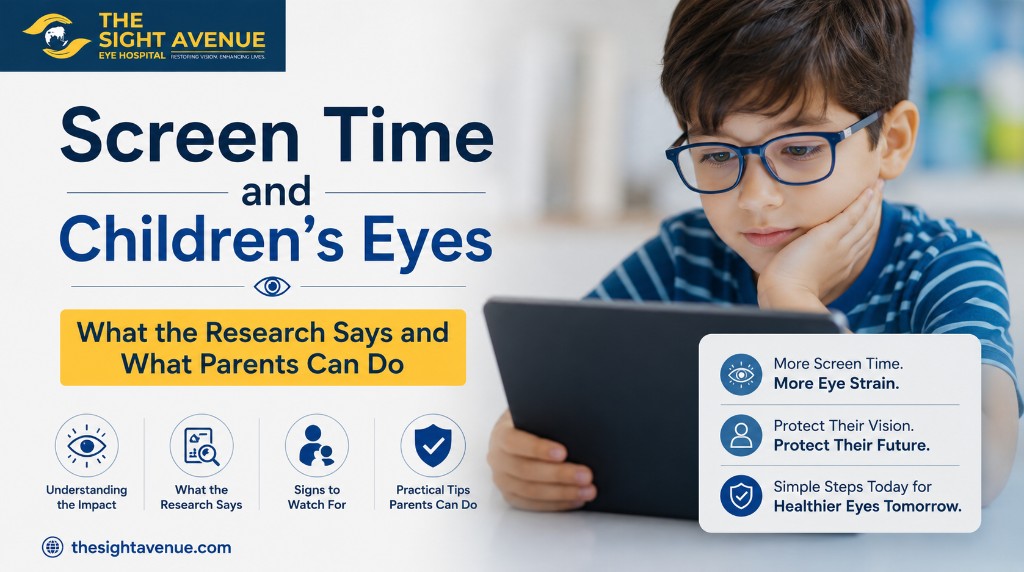
Every parent has had the conversation. Too much screen time. My eyes are getting worse. Get off the iPad. It is one of those parenting anxieties that feels instinctively right, even if the full picture is a little more nuanced than the headlines suggest.
The honest answer is this: screens themselves are not the enemy. What matters is how they are used, for how long, and at what age and whether children are spending enough time in natural light.
Myopia rates among Indian children have increased sharply over the past two decades. Paediatric eye specialists across the country are seeing children with significant spectacle prescriptions at ages that would have been unusual a generation ago. Understanding why this is happening and what can genuinely help is worth knowing.
Is Screen Time Actually Damaging Children'S Eyes?
The research on this is more specific than the popular narrative suggests. Screens do not directly cause permanent eye damage in the way that, say, UV light damages the cornea. There is no evidence that looking at a screen destroys retinal cells or causes structural harm to the developing eye.
What screens do consistently, across multiple large studies is two things. First, they reduce the time children spend outdoors. Second, they require sustained near-focus work, often at distances and for durations beyond what a developing visual system is designed to handle comfortably.
Both of these are relevant to myopia. Outdoor light specifically, bright natural light is now understood to have a protective role against myopia development. The mechanism involves dopamine release in the retina triggered by bright light, which influences eye growth. Children who spend more time outdoors consistently show lower rates of myopia onset and slower progression.
Near work, including screens, does not cause myopia by itself but sustained close focus sustained over hours without breaks, without adequate distance viewing, and without outdoor time, appears to contribute to myopic progression in children who are already susceptible.
Understanding Myopia Progression In Children
Myopia shortsightedness occurs when the eyeball grows slightly too long, causing distant objects to appear blurred while near vision remains clear. In children, the eyes are still growing, and myopia tends to increase year by year until late adolescence or early adulthood.
The steeper the progression, the higher the final prescription is likely to be. High myopia generally above minus six diopters carries a significantly increased lifetime risk of serious eye conditions including retinal detachment, glaucoma, myopic macular degeneration, and cataracts at a younger age. This is not about glasses becoming too thick. It is about a genuine health risk that grows with the degree of myopia.
Interventions that slow myopic progression are available and are used routinely at dedicated paediatric eye clinics. Orthokeratology (overnight reshaping lenses), low-concentration atropine drops, and specific soft contact lenses have all been shown in clinical studies to reduce the rate at which a child's prescription increases. These are not cures for myopia, but they can meaningfully reduce how high the final prescription becomes.
Signs Your Child May Have A Vision Problem
Children do not always tell you their vision is blurry. They often do not know it should be any different. Signals to watch for:
Squinting or narrowing the eyes to see the board at school, the television, or distant objects. Squinting reduces the aperture of the eye and temporarily improves focus; it is a sign the child is compensating for distance blur.
Sitting unusually close to screens, books, or the television. Children with myopia naturally gravitate toward the distance where their vision is clear.
Tilting or turning your head when looking at things. This can indicate an eye alignment issue or unequal vision between the two eyes.
Rubbing the eyes frequently. This can indicate eye strain, dry eye, or simply fatigue all worth investigating if it is a consistent habit.
Covering one eye or closing it when reading or looking at screens. Often a sign that one eye is significantly weaker than the other.
Headaches after school or reading sessions. The effort of sustaining focus through a refractive error or accommodation difficulty can cause genuine frontal headaches.
Declining school performance without an obvious academic explanation.
Digital Eye Strain In Children
Separate from myopia progression, children can experience digital eye strain (computer vision syndrome) from prolonged screen use. Symptoms include tired eyes, headaches, blurred vision after screen use, and occasionally double vision. These are functional symptoms: the eye is working harder than it should to maintain focus, leading to fatigue.
The contributing factors include screen distance that is too close, poor lighting, screens that are too bright or poorly positioned, and simply too many consecutive hours without a break.
The 20-20-20 rule is a practical starting point: every twenty minutes of near work, look at something twenty feet away for twenty seconds. This briefly relaxes the ciliary muscle that controls near focus and reduces cumulative strain. Twenty seconds of distance viewing is not a substitute for spending an hour outside but it is a reasonable habit to build.
Why Outdoor Time Matters More Than Limiting Screens
This is the finding that genuinely surprised the research community. The strongest predictor of myopia risk is not screen time per sec, it is the amount of time a child spends outdoors. Studies from Singapore, Taiwan, and China found that adding ninety minutes of outdoor time daily reduced the incidence of myopia onset by a significant margin, even when screen and reading time was unchanged.
This does not mean screens are harmless. It means the relationship is more complex than a simple correlation. Outdoor time provides bright light exposure, distance viewing, and physical activity all of which contribute to healthy visual development. A child who reads for two hours outside in natural light is probably at lower myopia risk than one who reads the same two hours indoors with artificial lighting.
Practical guidance for parents: aim for at least one to two hours of outdoor activity daily, even during school terms. Recess time, after-school play, and weekend outdoor activities all count. Screen time limits remain worthwhile but should not be the only focus.
When To Book An Eye Exam For Your Child
Before starting school, ideally between the ages of three and four: these screens for amblyopia (lazy eye), significant uncorrected refractive errors, and strabismus (squint), all of which become much harder to treat if missed in these early years.
At the start of each school year: once a child is in school, any vision problems affecting the board or near reading will affect learning. A brief eye check aligns well with school entry.
If you notice any of the signs above: do not wait for the scheduled check. If your child is squinting, sitting close to screens, covering one eye, or having headaches, book an appointment.
If there is a family history of high myopia: children with one or both myopic parents have a significantly higher baseline risk of developing myopia themselves, and earlier monitoring makes sense.
About the Specialist

Recent Post
FREQUENTLY ASKED QUESTIONS
A: Screen time does not directly damage the structures of the eye in the way that UV light exposure or injury does. The main concern with excessive near-work screen use in children is its contribution to myopia progression, shortsightedness getting worse faster and digital eye strain (tired, uncomfortable eyes after screen use). Both are significant but manageable concerns. The protective effect of outdoor time appears to be at least as important as reducing screen time in managing myopia risk.
A: Children should ideally have their first formal eye examination between the ages of three and four, before starting school. This is the window for detecting amblyopia (lazy eye) and significant refractive errors that respond best to treatment when caught early. After that, annual checks are reasonable once the child is school-aged. If you notice any visual symptoms or behavioural signs squinting, head tilting, covering one eye, sitting very close to screens do not wait for a scheduled check.
A: Children with myopia (shortsightedness) will often squint when looking at distant objects, sit very close to screens, or show reduced performance on tasks requiring distance vision. Children with hyperopia (longsightedness) may have excellent distance vision but struggle with sustained near work, causing headaches and eye strain. Astigmatism can cause blurring at all distances. A formal eye examination with a cycloplegic refraction where eye drops temporarily relax the focusing muscles to reveal the true refractive error is the definitive way to determine whether glasses are needed.
A: The 20-20-20 rule is a simple habit for reducing digital eye strain: every twenty minutes on screen or near work, look at something approximately twenty feet (six metres) away for twenty seconds. This briefly relaxes the ciliary muscle responsible for near focus, reducing the cumulative muscular fatigue that causes tired, strained eyes. It is a helpful habit for both children and adults, though it should be seen as a complement to, not a substitute for, regular outdoor breaks and adequate sleep.
A: Yes, and this is now an active area of paediatric eye care. Low-concentration atropine eye drops (0.01% to 0.05% strength) have been shown in multiple clinical trials to reduce the annual rate of myopic progression significantly. Myopia control glasses have now become a widely accepted method of decreasing myopia progression, and at our hospital we offer the same to kids needing it. These have peripheral defocus areas that help in decreasing the rate of increase of axial length of eye, thus helping in controlling the rate by which glasses power increases with growing age. Orthokeratology rigid contact lenses worn overnight that temporarily reshape the cornea also have strong evidence for slowing progression. Specific myopia-control soft contact lenses are another option for older children. Increasing outdoor time is the simplest and most accessible intervention. None of these approaches stop myopia from developing or cure existing myopia, but they can reduce how high the final prescription becomes, which has meaningful long-term health implications.
Eye problems? Searching for an eye specialist near me in Delhi NCR? The Sight Avenue has 5 eye clinics in Delhi NCR. Contact us today!
Eye Hospital in Delhi
- The Sight Avenue
- The Sight Avenue
- The Sight Avenue
E-82-A, Ground Floor, Hansraj Gupta Rd, Greater Kailash I, New Delhi, Delhi 110048
Email:enquiry@thesightavenue.com
Tel : 011-4666 0666
Mob : +91-8883330799
Fortis Hospital, Escorts Okhla, New Delhi
Fortis Hospital, Vasant Kunj, New Delhi