 Top Rated in Delhi NCR

Low Vision Clinic in Gurugram – Practical Support for Partial Sight
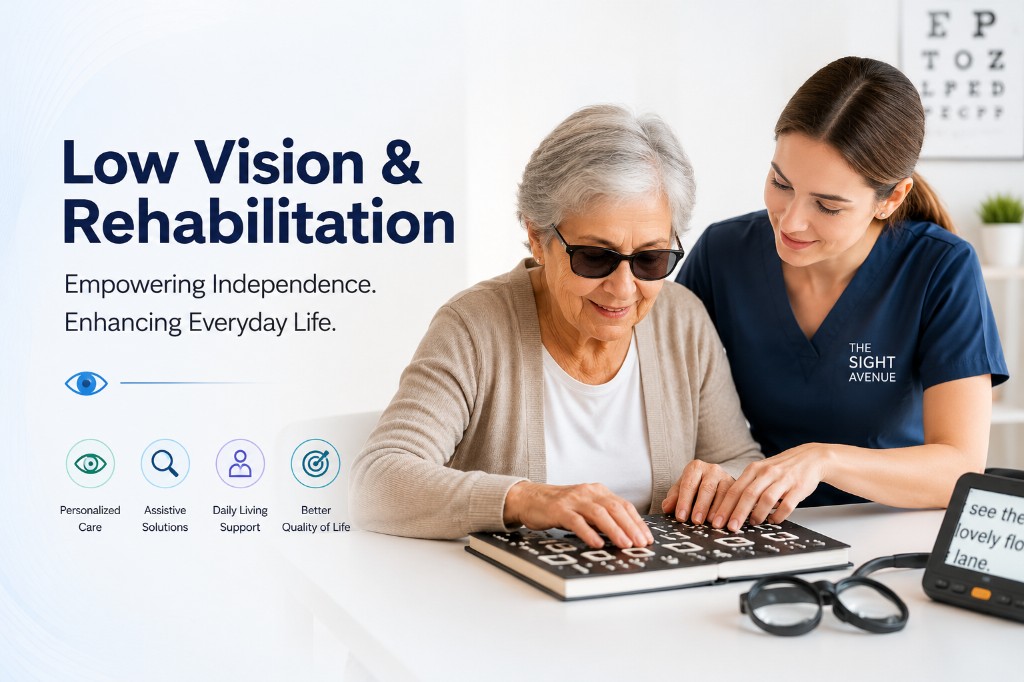
Losing vision even partially changes how a person experiences almost everything. Reading, recognising faces, cooking, navigating steps, following subtitles on a screen. The losses are quiet and cumulative, and they rarely get the same attention as the medical condition causing them.
Our Low Vision Clinic at The Sight Avenue exists because treatment is not always possible but support always is. Not every patient who walks through our doors can have their vision surgically restored. Many can, however, be given tools, techniques, and strategies that meaningfully change what their daily life looks like.
What Low Vision Means
Low vision refers to a level of visual impairment that cannot be fully corrected with regular spectacles, contact lenses, medication, or surgery. It is not blindness. Patients with low vision still have usable sight; they can perceive light, movement, shapes, and to varying degrees, detail. But that sight is significantly reduced.
The World Health Organization defines low vision as visual acuity worse than 6/18 in the better eye with the best possible correction, or a visual field of less than 20 degrees. In practical terms, this means a patient who struggles to read standard-sized print, recognise faces from across a room, or navigate an unfamiliar environment comfortably despite wearing their best glasses.
The distinction between low vision and blindness is important because the approach to each is fundamentally different. Blind rehabilitation is about non-visual adaptation. Low vision rehabilitation is about maximising the vision that remains.
The Emotional Side Of Low Vision
Patients rarely talk about this in a clinical consultation, but we see it constantly. There is grief in losing sight, even partial sight. Grief for the independence that is slipping, for the hobbies that have become difficult, for the feeling of being a burden on family. Younger patients grieve differently than older ones. Patients with sudden-onset low vision grieve differently than those whose condition has progressed slowly over years.
We acknowledge this not because an eye clinic can replace psychological support but because pretending the emotional dimension does not exist does not help anyone. Part of our approach is helping patients and their families understand what is happening, what can be done, and what realistic expectations look like going forward.
Conditions That Lead To Low Vision
Low vision can result from a wide range of eye conditions, including:
Age-related macular degeneration (AMD): The central retina deteriorates, causing loss of central vision while peripheral vision is preserved. Reading and face recognition become very difficult.
Diabetic retinopathy: Advanced diabetic eye disease can cause patchy vision loss or central vision deterioration that does not fully recover despite treatment.
Glaucoma: Advanced glaucoma causes significant peripheral visual field loss. Patients may have a narrow, tunnel-like field of remaining vision.
Retinitis pigmentosa and inherited retinal dystrophies: Progressive conditions that may begin with night blindness and peripheral loss and advance over years.
Optic nerve conditions: Optic neuritis, ischemic optic neuropathy, and congenital optic nerve conditions can reduce vision in ways that are not correctable with refraction.
Amblyopia: Severe untreated lazy eye can result in persistent low vision in the affected eye in adults.
The Assessment Process
A low vision assessment is different from a routine eye examination. We are not looking for what can be corrected, we already know what cannot. We are looking for what remains and how to use it best.
Our assessment covers:
Best corrected visual acuity how well the patient sees with optimal refraction, including high-powered lenses.
Contrast sensitivity how the patient performs in different lighting conditions and with reduced contrast between objects.
Visual field mapping identifies exactly which portions of the visual field are intact and which are affected.
Functional vision assessment real-world tasks that reveal how the patient's specific pattern of vision loss affects daily activities.
Lighting assessment many low vision patients benefit enormously from optimised task lighting, something that is rarely discussed in standard consultations.
Magnifiers And Low Vision Aids
There is a wide range of optical and electronic aids available for patients with low vision, and matching the right aid to the right patient requires a proper assessment.
Optical magnifiers include handheld magnifiers for spot tasks like reading labels, stand magnifiers for sustained reading, and spectacle-mounted high-plus lenses for hands-free near work.
Electronic video magnifiers (CCTV magnifiers) display magnified, high-contrast versions of text and images on a screen. These are among the most useful tools for patients who still want to read books, manage paperwork, or work with documents.
Distance telescopes help with tasks like watching television, reading a whiteboard, or navigating signage.
Tinted lenses and filter glasses improve comfort and contrast for patients with significant glare sensitivity or specific retinal conditions.
Smartphone accessibility features text enlargement, screen readers, reverse contrast are now genuinely powerful tools for low vision patients and are often underused simply because patients and families do not know they exist.
Daily Life Support And Rehabilitation
Beyond the aids themselves, low vision rehabilitation is about adapting the environment and developing strategies. This includes guidance on lighting changes at home, organising the physical environment to reduce navigation difficulty, techniques for safer mobility, and strategies for tasks like cooking and personal care.
For working-age patients, rehabilitation guidance includes workplace adjustments, assistive technology for screens and documents, and where appropriate liaison with employers or occupational therapists.
Guidance For Families
Families are almost always involved in the care of patients with low vision, and they often have their own anxiety and uncertainty to manage. We encourage family members to attend consultations where the patient is comfortable with this. Understanding the nature of the condition, what the patient can and cannot see, and how to help without taking over entirely is something we work through together.
There is a fine line between helpful support and overprotection that chips away at a person's confidence and independence. We try to help families find it.
Referral Pathways
If you are a clinician referring a patient to our low vision clinic, a referral letter summarising the diagnosis, current best corrected acuity, and relevant history is appreciated. We accept self-referrals too patients and families can contact us directly. If we assess that the patient's visual loss requires further medical investigation before rehabilitation begins, we will coordinate that internally.
About the Specialist

Recent Post
FREQUENTLY ASKED QUESTIONS
A: Low vision refers to significant visual impairment that cannot be fully corrected by glasses, contact lenses, or standard eye surgery. Patients with low vision have usable but significantly reduced sight enough to perceive light, shapes, and sometimes detail, but not enough for normal daily tasks without additional support or aids. It is different from total blindness. Low vision rehabilitation focuses on maximising the function of remaining vision through optical aids, electronic devices, and environmental strategies.
A: Standard glasses correct refractive errors like shortsightedness, longsightedness, and astigmatism. When vision loss is caused by structural damage to the retina, optic nerve, or other parts of the visual system, standard glasses cannot restore what has been lost. High-powered magnifying lenses and specialist optical aids can improve functional performance significantly in many patients which is what our low vision assessment explores but these are not glasses in the conventional sense.
A: A range of optical and electronic aids is available, matched to each patient's specific vision profile and daily needs. These include handheld and stand magnifiers, spectacle-mounted magnifying lenses, electronic video magnifiers that display enlarged text on a screen, distance telescopes, filter glasses for glare and contrast, and smartphone accessibility tools. The most useful aids vary considerably between patients. The assessment process is how we determine which options will actually make a difference for a specific person.
A: No. Blindness refers to total or near-total absence of visual perception. Low vision refers to significant but partial vision loss where the patient retains some usable sight. The rehabilitation approach for each is different. Low vision rehabilitation focuses on maximising remaining vision and adapting tasks and environments accordingly. Blind rehabilitation focuses on developing non-visual competencies. The two can overlap in patients with severe low vision, but the distinction matters for setting realistic goals and expectations.
A: You can refer a patient by contacting The Sight Avenue directly by phone, WhatsApp, or email. A brief referral summary diagnosis, current best corrected acuity, and any recent relevant investigations is helpful but not mandatory. Self-referrals from patients and families are equally welcome. We will triage the referral and contact the patient to schedule an appropriate appointment. Urgent cases for example, patients with recent significant visual loss requiring prompt rehabilitation support can be flagged and we will prioritise accordingly.
Eye problems? Searching for an eye specialist near me in Delhi NCR? The Sight Avenue has 5 eye clinics in Delhi NCR. Contact us today!
Eye Hospital in Delhi
- The Sight Avenue
- The Sight Avenue
- The Sight Avenue
E-82-A, Ground Floor, Hansraj Gupta Rd, Greater Kailash I, New Delhi, Delhi 110048
Email:enquiry@thesightavenue.com
Tel : 011-4666 0666
Mob : +91-8883330799
Fortis Hospital, Escorts Okhla, New Delhi
Fortis Hospital, Vasant Kunj, New Delhi