 Top Rated in Delhi NCR

Lasik cost in Delhi
The Ultimate Guide to LASIK Surgery Cost in Delhi: What to Expect
Here is a straight-to-the-point blog introduction:
The Complete Guide to LASIK Surgery Costs in Delhi NCR
If you are considering LASIK surgery to replace glasses or contact lenses, understanding the financial side is just as important as choosing the right surgeon.
In Delhi NCR, the cost of LASIK ranges anywhere from ₹25,000 to over ₹1,40,000 for both eyes. The final price tag depends on three key factors:
-
The Technology Used: Basic blade LASIK sits at the lower end of the price spectrum, while advanced procedures—like Femto-LASIK, Contoura Vision, and SMILE—cost significantly more due to higher precision and faster recovery times.
-
Your Prescription: Higher refractive errors or custom mapping requirements can increase the total cost.
-
Clinic & Surgeon Credentials: Specialized eye centers with top-tier technology and experienced surgeons charge a premium.
What is the Average LASIK Eye Surgery Cost Delhi?
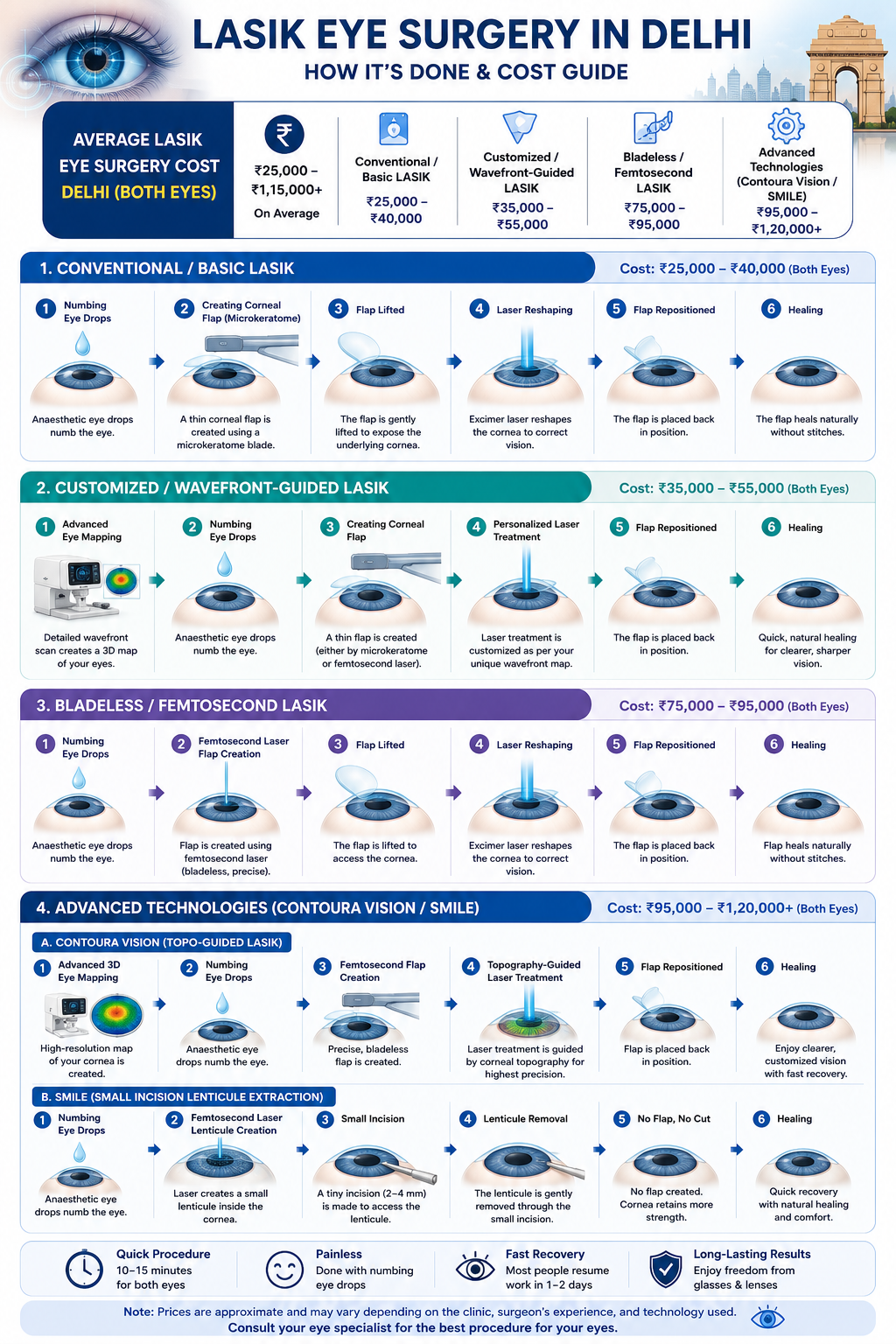
On average, the lasik eye surgery cost delhi ranges from ₹25,000 to ₹1,15,000 or more for both eyes. This wide price gap exists because "LASIK" is often used as a blanket term for several distinct types of laser eye surgery. Each variation leverages different technological advancements to fix issues like nearsightedness, farsightedness, and astigmatism.
To help you plan your budget effectively, let’s look at the estimated pricing models based on the tier of technology used:
-
Conventional/Basic LASIK: ₹25,000 to ₹40,000 (Both Eyes)
-
Customized / Wavefront-Guided LASIK: ₹35,000 to ₹55,000 (Both Eyes)
-
Bladeless / Femtosecond LASIK: ₹75,000 to ₹95,000 (Both Eyes)
-
Advanced Technologies (Contoura Vision / SMILE): ₹95,000 to ₹1,20,000+ (Both Eyes)
Decoding the Tech: Why Prices Differ
When evaluating the lasik surgery price delhi ncr, the single biggest cost driver is the technology deployed for the procedure. The basic objective of any laser vision procedure is corneal reshaping—altering the curve of your cornea so that light focuses perfectly onto your retina.
1. Traditional Blade LASIK vs. Blade-Free Options
The conventional approach makes use of a manual surgical knife referred to as the microkeratome which creates a thin corneal flap before the use of the laser to reshape the eyes. As a result, because it uses mechanical instruments, this approach is the most economical.
On the other hand, the modern approach is bladeless lasik cost delhi. Bladeless lasik is another term for this technique. In contrast to the conventional one, it does not employ any manual blades. Instead, the femtosecond laser makes a corneal flap with micron-level accuracy. It is costly but preferred by patients due to its improved safety and reduced chance of complications.
2. Contoura Vision and SMILE
In case you opt for high-end services at a professional eye care facility like The Sight Avenue, then you might encounter advanced procedures such as Contoura Vision and ReLEx SMILE. The former creates a map with 22,000 points of corneal surface elevation in order to correct any minor irregularities while the latter works through flapless technology using an extremely tiny incision. Such highly accurate methods need significant machinery expenditure.
Factors That Influence the Best LASIK Surgeon Cost Delhi
When looking at quotes, it is important to remember that the cheapest option isn’t always the best one when it comes to your vision. The overall best lasik surgeon cost delhi is determined by a collection of medical and operational variables:
-
The Surgeon’s Experience: Experienced ophthalmologists who already carried out thousands of surgeries of such a type definitely cost more. They are very useful when checking whether you can perform the surgery and how risky it is.
-
Pre-Surgery Screenings:Any operation on your eyes starts with a number of tests before. Corneal topography, pachymetry, and testing the tear film of your eyes are just a few of the many diagnostics.
-
Post-Operative Care: If you want to guarantee the success of the surgery, you have to arrange certain visits after it. Antibiotic and other kinds of drops, additional visits – all these expenses are included into the package of the premium price.
-
Hospital Infrastructure: Super-specialty eye hospitals that invest heavily in sterile modular operating theaters and international safety protocols will feature different pricing structures than smaller optical clinics.
Hidden Costs to Watch Out For
When comparing prices between multiple healthcare facilities, always ask for an all-inclusive itemized breakdown. Some centers might advertise an incredibly low base price, only to tack on extra fees later for:
-
Pre-op diagnostic scans
-
Post-op medications and protective eyewear
-
Enhancement procedures (if a minor touch-up is required a few months later to perfect your visual acuity)
Reputable institutions like The Sight Avenue emphasize transparent pricing models, ensuring patients know exactly what their treatment covers upfront. Furthermore, modern centers often provide financial flexibility through easy EMI options and partnerships with major insurance TPAs for cashless benefits where applicable.
The Verdict: Is LASIK Worth the Investment?
While spending between ₹40,000 and ₹1,00,000 might seem like a heavy upfront expense, it helps to view it as a long-term investment. Consider the cumulative cost of buying designer frames, changing your prescription lenses every couple of years, and purchasing boxes of daily or monthly contact lenses along with cleaning solutions. Over a decade, the recurring costs of temporary vision fixes easily outpace the one-time price of permanent laser correction.
More than the financial math, the lifestyle freedom being able to swim, play sports, travel, and simply wake up seeing the world in high definition makes it one of the most high-satisfaction elective procedures available today.